

The unconventional Kouros of Palaikastro
Highlights
The undisputed centrepiece of the Archaeological Museum of Sitia is unlike any other discovered to date: a diminutive chryselephantine statue of a young man, rightfully considered one of the most extraordinary masterpieces of Minoan art.
If the word kouros naturally brings to mind austere, larger-than-life male figures carved out of marble, the Kouros of Palaikastro defies convention. Although it owes its contemporary name to the characteristic upright stance with the left leg forward – the defining feature of the celebrated Archaic Greek kouroi, originally inspired by Egyptian sculptural conventions – its unusual materials and exceptional craftsmanship set it apart.
Most of the statuette’s body is exquisitely carved in hippopotamus ivory, while the arms and legs were partially covered in gold sheets. The hair is fashioned from green serpentine, the eyes from rock crystal, the joints were made of wood and the base was decorated with blue glass paste, inlaid with tiny gold discs.
No fewer than six different materials were combined to create this remarkable 54cm-tall chryselephantine statuette of a youthful male figure, discovered in the Minoan settlement of Palaikastro and currently exhibited at the Archaeological Museum of Sitia. Most of the body is exquisitely carved in hippopotamus ivory, while the arms and legs were partially covered in gold sheets. The hair is fashioned from green serpentine, the eyes from rock crystal, the joints were made of wood and the base was decorated with blue glass paste, inlaid with tiny gold discs.


Its size and precious materials indicate it was used in cult worship, most likely representing an unknown male deity – perhaps a precursor to Zeus. Yet this unique work of art met a violent end. Both the statuette and the shrine that housed it perished in a fire at the beginning of the 15th century BC, most likely during a raid. In fact, archaeological evidence suggests that the figure was deliberately smashed.
Over the course of four years (1987-1990) and three excavations, more than two hundred fragments were recovered, many bearing the scars of the devastating fire. The painstaking work of reconstructing the statuette and gradually unlocking its secrets can only be described as monumental. All of these years later, archaeologists continue to hope that technological advances will one day allow them to complete this intriguing archaeological puzzle.

Read also
The Phaistos Disc: An eternal enigma
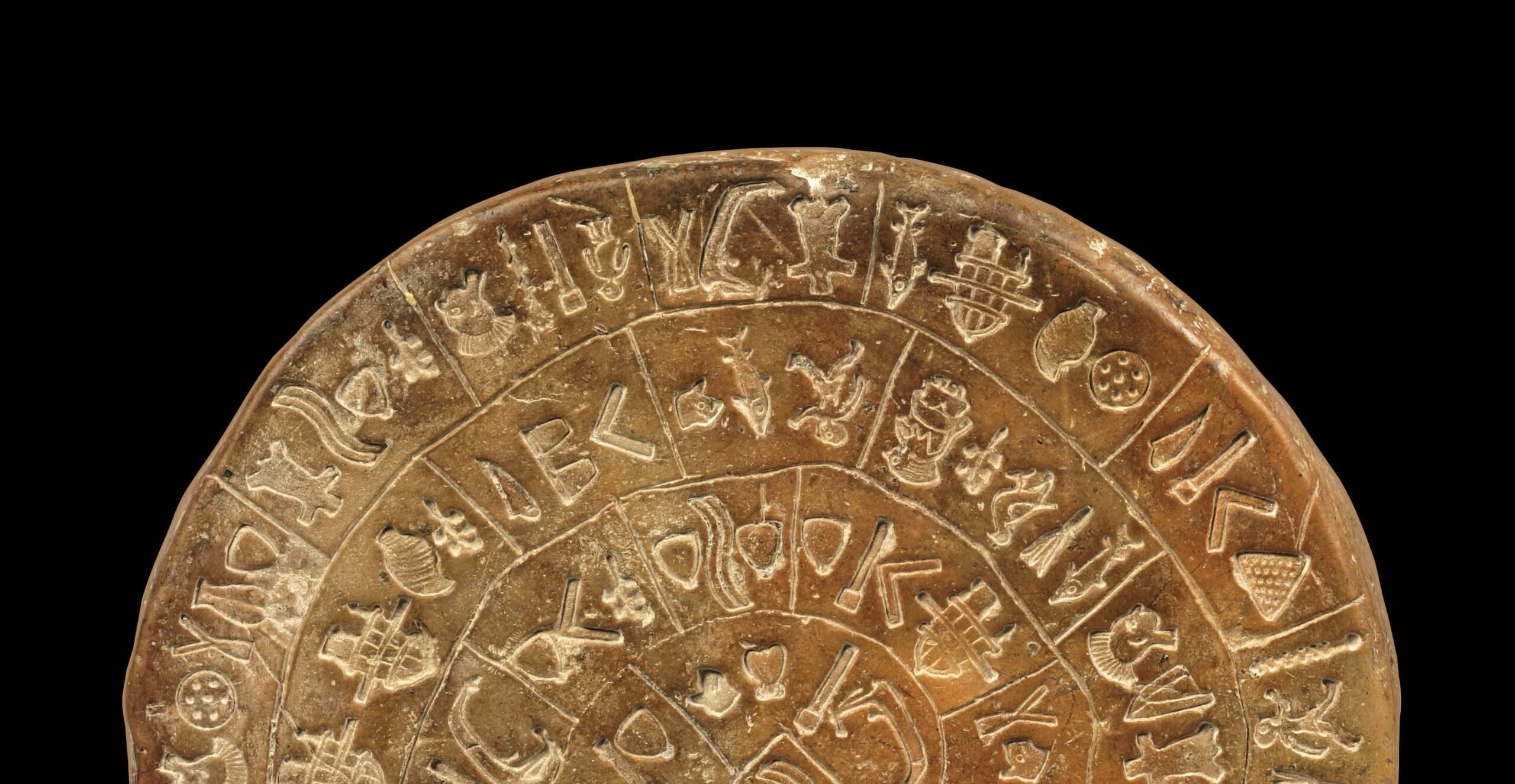
The Phaistos Disc is not just one of the most iconic discoveries of the Minoan civilization, but also one of the most enigmatic, with countless theories attempting to decipher its content.
The celebrated ladies of Greek prehistory

Carved from marble or modelled in clay, priestesses or goddesses lending their shapely silhouettes to votive offerings and ritual objects, female figures dominate the figurative art and pottery of prehistoric Greece, from the islands of the Aegean all the way to Minoan Crete.
The Kore of Thera: One of the great mysteries of Greek archaeology

A century after the systematic excavation of the cemetery of Ancient Thera, the distinguished Santorini-born archaeologist Charalambos Sigalas made an extraordinary discovery just a few centimetres beneath the surface of the earth.